
Our study with ZHAW made one thing clear: Swiss SMEs are successfully using data privacy as a selling point today. Customers are increasingly drawn to: “100% of the data stays in Switzerland.” Yet the same customers report using ChatGPT quite carelessly in their private lives. In other words: data privacy matters to everyone, but almost nobody understands it. Many people think a lot about security in certain areas, while unconsciously ignoring it in others. Why this isn’t a contradiction but an opportunity, and why having your own AI is more than just a requirement, is what this article shows.
Content
- What we found out
- Why does data privacy matter to everyone, yet almost nobody understands it?
- How does data privacy become a selling point?
- How is trust built?
- Whose AI?
- Conclusion
- Now it’s your turn
What we found out
Last week I presented the results of our study with ZHAW and Innosuisse. We asked eight SMEs from eight industries whether they would train their AI together with other companies, without handing over their customer data. Nobody said no. The companies had doubts, but not about data privacy, rather about the benefit.
That’s exactly where this article comes in: what does data sovereignty actually get you, beyond simply following the rules?
Why does data privacy matter to everyone, yet almost nobody understands it?
The sentence “Data privacy matters to everyone, but nobody understands it” comes from an interview in our study. The company meant its own customers: they demand a Swiss data location while privately using AI tools from the US, including ChatGPT.
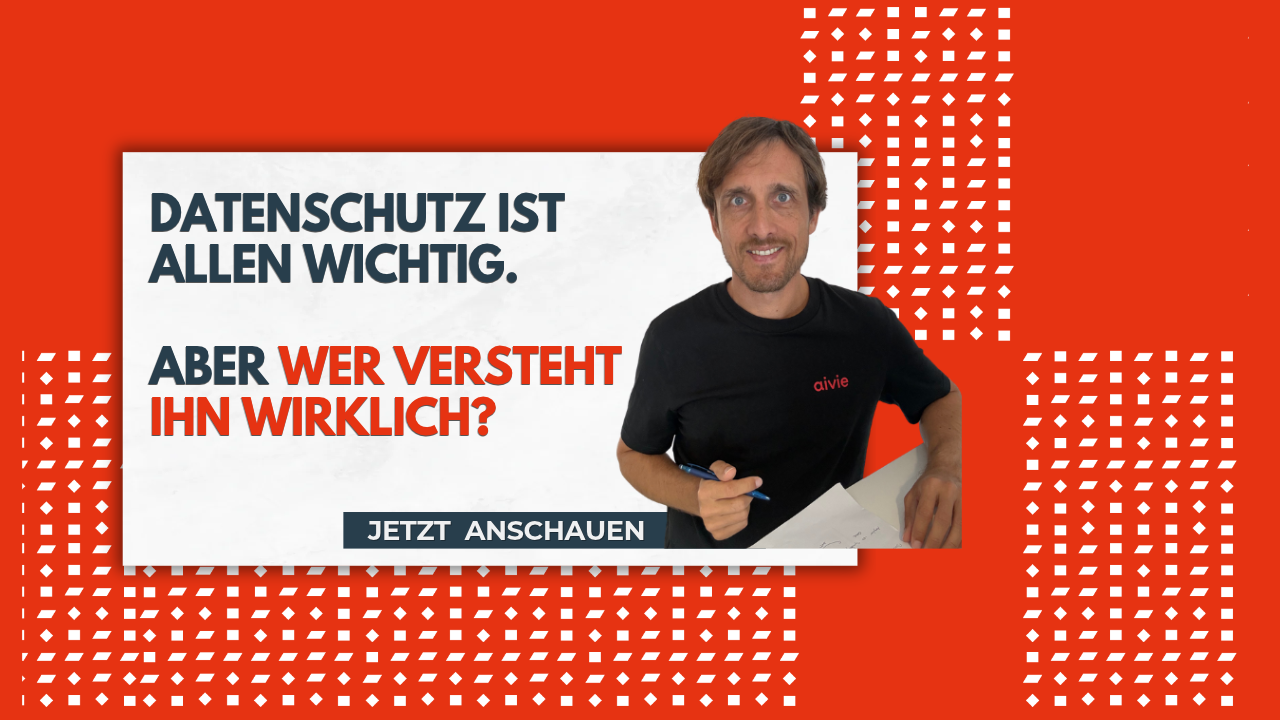
I know this well. When I started arguing “your data belongs to you” back in 2017, a lot of people just smiled politely at me. Today, the same question plays a central role in almost every initial conversation: with management, with legal, and with procurement. And there’s one sentence I hear almost every time: “We’re certainly not giving our data to AI.”
How does data privacy become a selling point?
You could argue: if people don’t understand it anyway, why bother? The study shows something different. The SME from the beginning isn’t an isolated case. Two agencies name data sovereignty and independence from US tech giants as the main reason for choosing a Swiss solution. And one company even said it would pay more for a Swiss model that can demonstrably keep up.
For these companies, data privacy isn’t just a box to tick. They see the added value and use it to sell, too. Your customers don’t need to understand the details of how data privacy works. They need to be able to trust you. And that’s something you can show them.
How is trust built?
For most companies in the study, quite simply: they know someone at Aivie and trust that person. Certificates or transparency reports matter less. One person put it quite openly: “We’re pretty trusting.” The study sees this as both an opportunity and a risk.
Others want more. One company wants to see references before getting on board. Another wants clear rules and a human to always have the final say. A third wants to know exactly which model the whole thing runs on.
For me, trust is also built through transparency. Aivie is based on open source, so anyone can look at the code. We’re also happy to provide insight at any time in other ways. On request, our customers always have access to their own database. And of course, we work with standards and certifications.
We’re also big believers in customer cases that show what companies have been able to achieve with Aivie. They’re a simple way to explain and inspire. I’d rather show what’s possible than talk at length. That always mattered most to me whenever I was on the other side, looking to invest in something. That’s why we’ve published several customer cases, for example how Studer Cables digitized its supplier processes or how Ferris Labs doubled its contacts.
Whose AI do you use?
When it comes to AI, I always ask the same question. Not: AI, yes or no? But: whose AI, and on whose infrastructure does it run? If you feed your customer data into an AI that’s shared by everyone, you’re also giving away your knowledge. With your own AI, your knowledge stays with you, and you can tell your customers exactly where their data is stored. I’ve written more about this in “Your data is your treasure”.
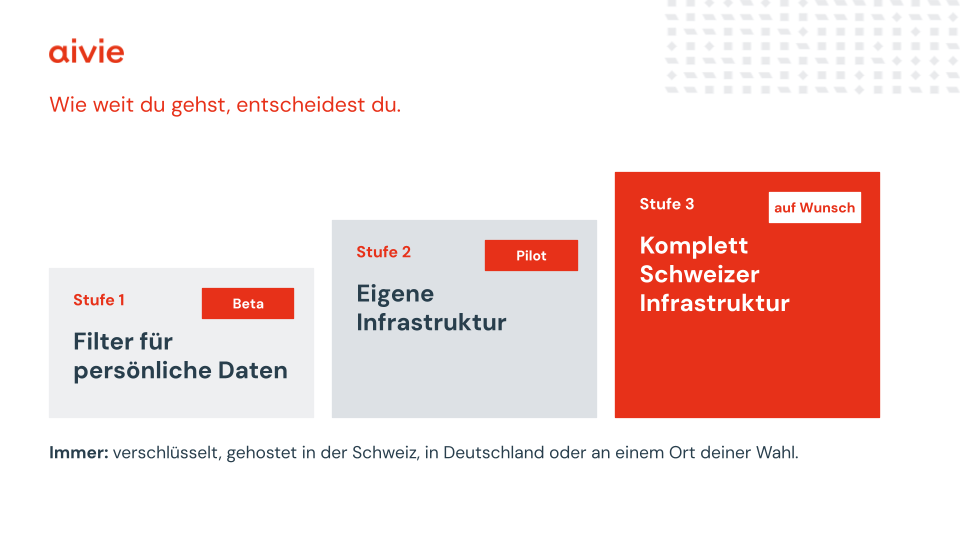
At Aivie, we’re building this in stages. It starts with a filter that sorts out personal data before anything even reaches the AI. This is already live in beta for our customers. And it goes all the way to a fully dedicated infrastructure, which we’re currently piloting with a first customer. In every case: the data is encrypted, hosted in Switzerland, Germany, or a location of your choice, and on request, everything can run entirely on Swiss infrastructure. How far you go is up to you.
Conclusion
Data privacy matters to everyone, but almost nobody understands it. That’s not a reason to ignore it, but a reason to make it visible. Some SMEs are already selling on the fact that their data stays in Switzerland. Having your own AI turns this into more than just a requirement: it becomes an argument that scores points with your customers.
Now it’s your turn
For our pilot, we’re looking for more SMEs who want exactly that: their own AI for their marketing, with their own data, and the certainty that everything they put in stays with them. Want to get involved? Then book a short call.
All beginnings are easy
Whether you’re a marketing manager, CMO, CTO, CEO, founder or simply curious: we will discuss your individual case in a 30-minute online appointment.
Using a comparable customer use case, we will show you how marketing automation can be applied in your business.
The appointment is free of charge.
