

The open rate tells you almost nothing about whether someone has read your email. It only shows that a tiny image was loaded, and that can happen without human interaction. Since this year, this very image has also become a legal issue in France and Italy. In Switzerland, it’s different. Here you can read why I no longer consider the open rate a reliable signal and what counts for us and our customers instead.
Content
- What does the open rate actually measure?
- Why is the open rate so unreliable?
- Why is a pixel also a cookie?
- What applies in Switzerland?
- What do I measure instead?
- Is website tracking harmless then?
- What does this mean for Aivie?
- What can you do now?
What does the open rate actually measure?
When you send an email, it contains a tiny, invisible image, a so-called tracking pixel. If the email program loads this image, it reports it back to the sender. And your tool records: “Opened.” How this works in Aivie is explained in the Email Basics.
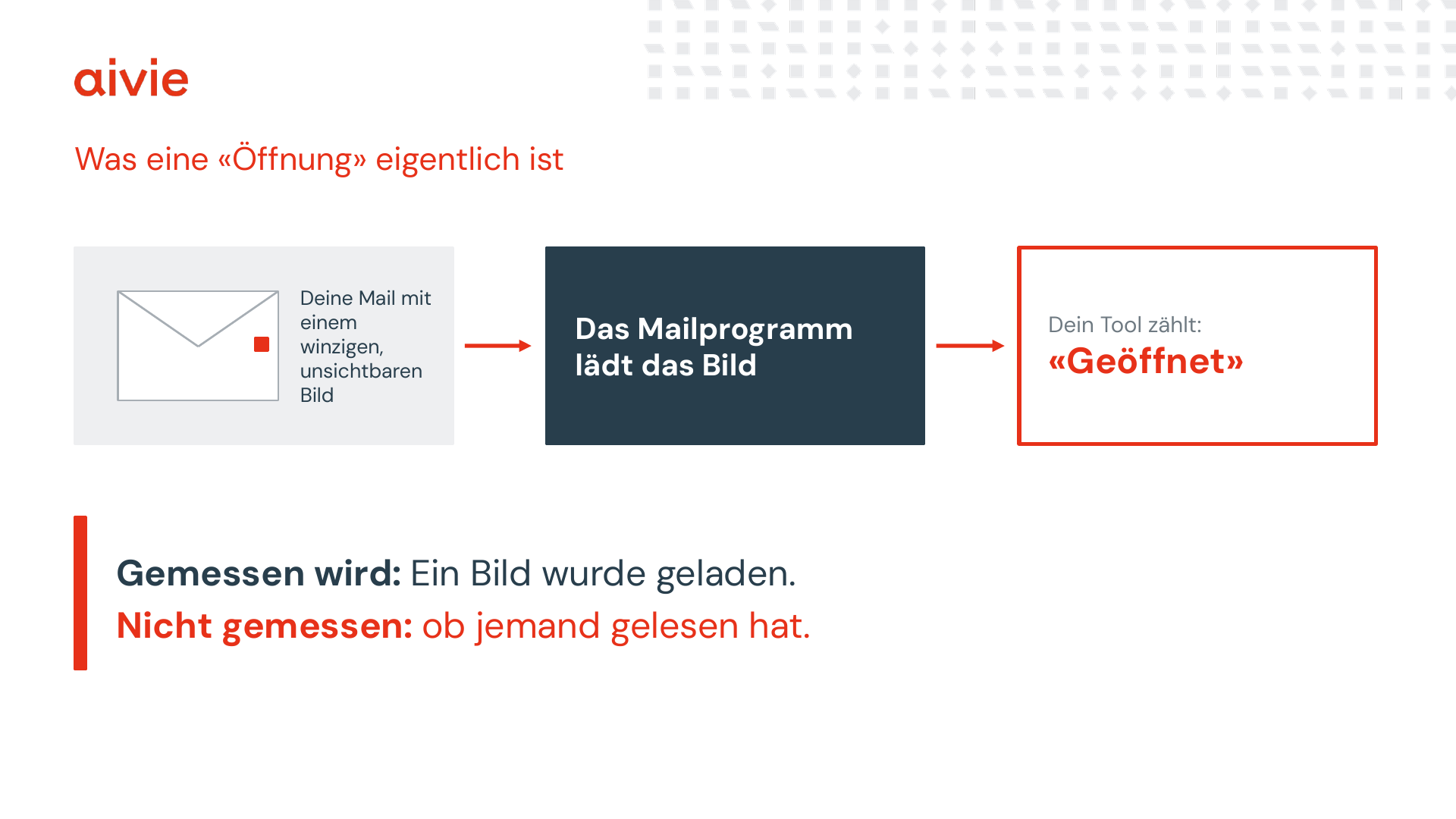
Note what is being measured here. Not that someone has read it, but: that an image has been loaded.
Why is the open rate so unreliable?
The image can also be loaded without any human ever looking at it. And it can be missing even if someone reads the email. Three reasons are responsible for this:
- Automatic preview. Some email programs load content in the background before you’ve even looked at the email. Apple Mail, with its privacy protection, can automatically load images. Then your tool counts an open, even though no one may have clicked on the email.
- Security software and automated systems. They check incoming emails and can trigger activity that looks like a human.
- Blocked images. Those who block images are not counted, even if they read the email.
So the number can be too high and too low. And you never know in which direction. That’s why it’s not a real signal for me. A number where you don’t know if it’s too high or too low is not suitable for decisions.
Why is a pixel also a cookie?
The second reason is legal, and it affects many Swiss SMEs that also send emails to France or Italy.
France: In March 2026, the data protection authority CNIL adopted a recommendation, which was published in April. The core: a tracking pixel in an email is treated like a cookie. This generally means: prior consent, unless a narrowly defined exception applies. For addresses already on the mailing list, a transitional period applied until July 14, 2026.
Italy: The data protection authority Garante issued its own guidelines in April 2026. There, too, tracking individual opens generally requires consent. Exceptions exist, for example, for anonymous overall statistics. However, the pixel must be the same for all recipients of a campaign, and IP addresses and technical data about the email program must also be anonymized. As soon as a campaign reacts to the opening by an individual person, it is no longer anonymous statistics. The transitional period for existing mailing lists ran for six months from publication in the Official Gazette, i.e., until the end of October 2026.
Important for you: The country of the recipients counts, not the sender’s location. If you, as a Swiss company, send emails to recipients in France or Italy, you must assume that this affects you.
What applies in Switzerland?
In Switzerland, three things apply simultaneously:
- Unfair Competition Act. For mass advertising via email, you generally need prior consent, you must be able to prove it, and an easy unsubscribe option is required. This concerns the newsletter itself, not the pixel. More on this in the article about Double Opt-In with Mautic.
- Data Protection Act. Anyone who assigns individual opens to a person processes personal data. This must be transparent, for example, in the privacy policy.
- Telecommunications Act. Article 45c requires that users be informed and able to refuse the processing of data on third-party devices.
In spring 2026, the Federal Data Protection and Information Commissioner (FDPIC) published a fact sheet on cookies and online tracking. In it, he explicitly mentions tracking pixels that detect whether an email has been opened. And he states: Switzerland relies on transparent information and a right to object.
However, the fact sheet does not contain its own detailed rules for the email pixel itself. In my opinion, Switzerland has therefore not explicitly regulated this. But it should at least be included in the privacy policy.
| Country | Principle for the pixel | Status November 2026 |
|---|---|---|
| Switzerland | Information and Opt-out* | No specific rules for the email pixel, classification via TCA, DPA, and FDPIC fact sheet |
| France | Generally consent | CNIL recommendation 2026, transitional period until July 14, 2026 |
| Italy | Generally consent | Garante guidelines 2026, transitional period until end of October 2026 |
* Clarification (November 24, 2026): In Switzerland, it is not always sufficient to simply “inform and provide an opt-out.” According to the FDPIC factsheet, prior, express consent is required if data processing is unexpected, carries a high risk, or involves sensitive personal data. This can also apply to website tracking, for example, if you associate behavior on your website with a known individual. Therefore, check whether your analysis is foreseeable for your recipients and inform them clearly about it. If in doubt, have it legally reviewed.
The practical problem arises when your list is mixed: one mailing list, one send, but recipients in several countries with different rules.
What do I measure instead?
My recommendation: I would generally switch off open tracking. At least if you want to play it safe.
The loss is small. A signal that is so unreliable won’t be missed for long. Sure: your statistics and all automated campaigns based on them will no longer work. You’ll have to rebuild or rethink them.
Because there are stronger signals. Imagine a staircase:
- The open. It’s at the very bottom and weak.
- The click. Someone clicked something in your email. That’s a conscious action.
- Behavior on your website. Which pages did the person view? For how long? How often did they return?
Someone who views your pricing page three times in a week sends a completely different signal than someone whose email was loaded somewhere in the background.
I have customers who measure exactly that. And they act on it. Depending on the behavior, they send a suitable follow-up, offer a conversation, and some even call the person personally. The pattern behind it: It’s not the number that counts, but the next meaningful step for that one person. How you can evaluate such signals is shown in the article on Lead Scoring with Mautic.
Is website tracking harmless then?
No. Measuring website behavior is also tracking, and it usually happens via cookies. In Switzerland, according to the FDPIC fact sheet, this requires informing and enabling objection. In the EU: prior consent.
So the message is not “opens bad, website tracking harmless.” Rather: Use the better signals, but collect them consciously, transparently, and with clear information. And rather collect less data that is more meaningful.
What does this mean for Aivie?
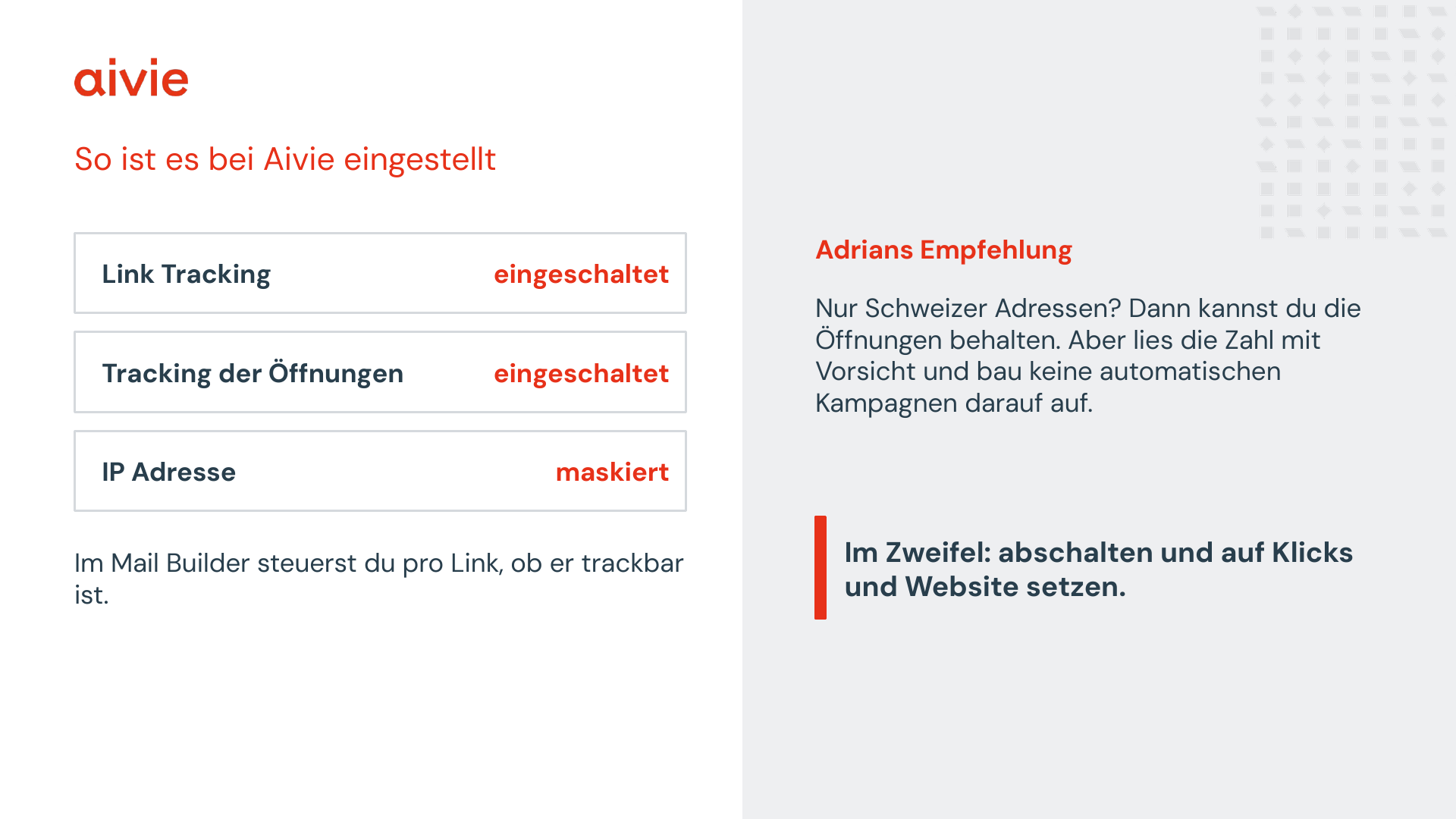
In Aivie, link tracking and open tracking are enabled, and the IP address is masked. In the Email Builder, you control for each link whether it is trackable. However, a masked IP alone does not make open tracking an anonymous statistic in the sense of the Italian exception. Those who operate Mautic themselves can find the options in the Settings under “Append tracking pixel into Email body?”, “Disable trackable URLs” and “Anonymize IP.”
My own recommendation: If you only send to Swiss addresses, you can keep open tracking. But enjoy the number with caution and don’t build automated campaigns on it. When in doubt, I would rather switch it off and rely on clicks and website behavior.
Important: This is not legal advice. If you have recipients in multiple countries and are unsure, have it checked.
What can you do now?
The most important things in three sentences: An open is not a read, the number is too unreliable for decisions. In France and Italy, the pixel now generally requires consent; in Switzerland, information and objection apply. Focus on clicks and behavior on your website, and collect them transparently.
Next, check:
- Is open tracking enabled in your tool?
- Which campaigns are based on the condition “email opened”?
- Do you have recipients in France or Italy?
One more quick outlook: the Mautic community is currently working on a project called “Marketing without Surveillance,” which includes, among other things, a central Privacy Center for tracking settings. The project started in September. What’s coming and what it means for Aivie, I explain in the article Mautic Privacy Center: On the Way to Marketing Automation without Surveillance.
And if you have any questions, write to me.
All beginnings are easy
Whether you’re a marketing manager, CMO, CTO, CEO, founder or simply curious: we will discuss your individual case in a 30-minute online appointment.
Using a comparable customer use case, we will show you how marketing automation can be applied in your business.
The appointment is free of charge.
