
Imagine you can make cheese better than almost anyone else. Not by luck, but because over the years you’ve learned how it really works: which milk, which temperature, how long it needs to mature. That knowledge is your treasure. Now imagine you give that treasure to an AI that everyone in the world uses. The next day someone asks: How do I make the best cheese? And the AI tells them. With your knowledge. That’s how fast it can happen.
That’s exactly the concern I hear almost every week in conversations with SMEs. In almost every one, someone says: “We’re definitely not giving our data to any AI.” And the concern is justified. The only question is whether that means you have to drop AI entirely — or whether there’s a middle way.
What’s really in your data
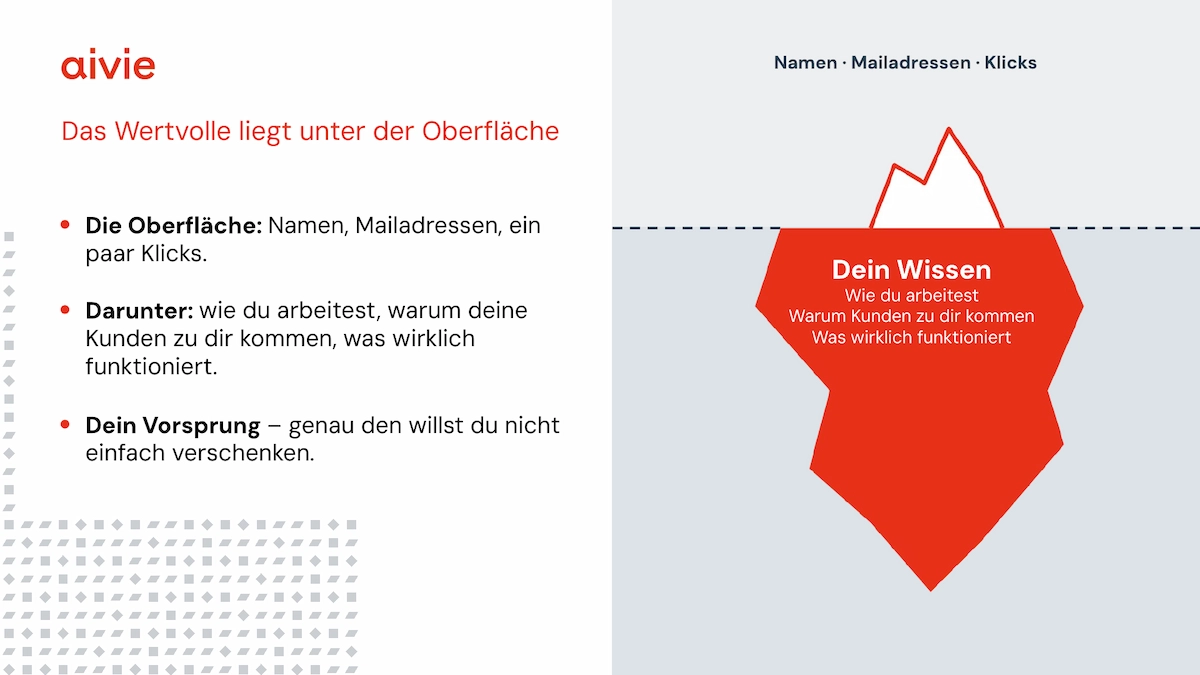
Most people think of their data as names, email addresses, and a few clicks. But that’s just the surface. Underneath is what really matters: how you work, why your customers come to you and not the business next door, and what has worked over the years. That’s the part that makes you special. And that’s exactly what you don’t want to give away. If you want to stay in control here, you shouldn’t hand over your customer data.
Why the big players are so cautious
A pharmaceutical company doesn’t hand over its formulas. A bank doesn’t show anyone who transfers how much, when. A factory doesn’t leave its blueprints lying around. Not because they’re stubborn, but because that’s exactly their competitive edge.
How sensitive this topic is becomes clear in a dispute currently in court. The New York Times accuses OpenAI of using its texts without permission to make its AI smarter. Nothing has been decided; the case is still open. But it highlights the core question: whose knowledge ends up inside an AI like that? A recent comment piece in the NZZ summed it up well. The first major hurdle is the question of who the data actually belongs to. We’re seeing the same pattern in marketing in many places right now.
The wrong question: AI, yes or no
Many approach the topic the wrong way. They ask: AI, yes or no? That’s already the wrong question. Because saying no costs you something, too. A practical example: you want to email your customers a short summary of what’s new at your company. An AI could draft that for you in just a few minutes. Really handy. It only becomes sensitive when the tool quietly takes your internal information with it and learns from it.
So the better question isn’t yes or no. It’s: whose AI are you using, and where does it run? Who gets to decide that isn’t a side issue—it’s the core. And between no AI at all and handing everything over to a big corporation, there’s a middle way. It’s not nearly as complicated as it sounds.
The second hurdle: it has to work day to day
So it doesn’t sound too easy, here’s an honest warning. There’s a second hurdle, and it has nothing to do with protecting data—it’s about everyday reality. An AI is a bit like a new employee. It needs onboarding, well-structured information, and clear tasks that fit your business. Without that groundwork, it goes wrong. And that happens often.
Depending on the study, between 70 and over 90 out of 100 AI projects in companies end up delivering nothing. They either don’t make money or never really land in day-to-day operations. The RAND research group in the US puts it at around 80 out of 100; a well-known MIT study even puts it at 95 with no noticeable effect. The reason is almost always the same: in the demo, everything shines. In real life—with real data and real processes—it collapses. What matters isn’t the prettiest demo, but the preparation and the place where the whole thing runs. We’ve built up this experience over years with open software.
The middle way: your own AI
The goal is your own AI—one that nobody else can access, that belongs to you, and that you control. Not one where your data goes in at the front and eventually comes back out at someone else’s. That’s exactly what we build at Aivie for small and mid-sized companies. Instead of renting from a big provider and putting your data into a shared pool, you get your own space—tailored to what you actually need.

It’s not all or nothing—more like a house. For some, a good door with a solid lock is enough: a filter that strips out personal details before anything goes outside. If you need more protection, you build the whole house on your own land, so to speak, with everything hosted by Swiss providers from start to finish. How far you go is up to you. That this really works is shown, for example, by Threema, where data protection isn’t marketing—it’s built in from day one.
The foundation under all of this is open software—what people call open source. It doesn’t belong to a single corporation that can do whatever it wants with it. You have your own version, your data stays your data, and nothing quietly learns in the background. We’ve described what day-to-day work looks like on this open foundation here.
Conclusion
Your competitive edge is in your data. The question isn’t whether you use AI, but whose AI you use and where it runs. And yes, it takes a bit of groundwork. But that’s exactly the difference between a nice demo and a system that actually helps you day to day. Ask yourself, honestly, what the safe path really costs you. In most cases, it’s less than you think. If you want to run the numbers for your situation, book an appointment or see Aivie in a demo.
All beginnings are easy
Whether you’re a marketing manager, CMO, CTO, CEO, founder or simply curious: we will discuss your individual case in a 30-minute online appointment.
Using a comparable customer use case, we will show you how marketing automation can be applied in your business.
The appointment is free of charge.
