
Approve every single AI suggestion? With tens of thousands of customers, that’s an impossible amount of work. Not checking anything at all? Unthinkable for medical content. So the question isn’t: human or AI? The question is rather: how much control is needed at which point? This is exactly what eight SMEs told us in our study with the ZHAW and Innosuisse. And we are building our Aivie AI based on this knowledge. This article describes exactly what that looks like.
Content
- What it’s about
- Insight 1: Everyone wants to know why
- Insight 2: Approving everything individually isn’t feasible
- Insight 3: How much control is needed depends on the risk
- What staged approval can look like
- Insight 4: It doesn’t have to be in real-time
- Our pilot
- Join us
What it’s about
Together with the ZHAW and Innosuisse, we asked eight Swiss SMEs: Would you train an AI together with others if you didn’t have to give up your customer data? In the first post, I showed that nobody said no. People doubted the benefit. The second post was about trust and why data protection can be a selling point. Today is about the last big question: How much should the AI decide for itself?
The idea is simple. The AI looks at what a contact is doing and suggests the next step: what content you send, when, and to whom. For example: someone downloads a white paper on your website. Usually, nothing happens because nobody has time to follow up. The AI could tell you here: send this person this article now.
But: is it allowed to send it itself right away? Or do you have to say yes every time? Important for context: eight interviews are not representative. But they show very honestly how SMEs think about the topic.
Insight 1: Everyone wants to know why
Everyone we interviewed agreed: when the AI suggests something, they want to know why. They want to understand why this suggestion makes sense, otherwise they don’t trust it. They also want to be able to identify errors. Nobody wants a black box when it comes to such important topics.
One company said something else interesting: instead of a long explanation in text form, a clear value would also be enough for them. A number that says how confident the AI is.
Insight 2: Approving everything individually isn’t feasible
One company in the study has tens of thousands of customers and a small team. Looking at every AI suggestion individually every day? Impossible. The statement on this was very clear:
“It would have to work automatically, otherwise it wouldn’t be a help to us.”
Another company saw it similarly. Better to work with templates and stages than to check everything individually.
Insight 3: How much control is needed depends on the risk
Now it gets interesting. The same people want full automation or strict individual review depending on the case. One company explained it like this: for its expensive product with a lot of consulting, it would monitor the suggestions itself. For a cheap mass-market product, on the other hand, it would give the AI full power.
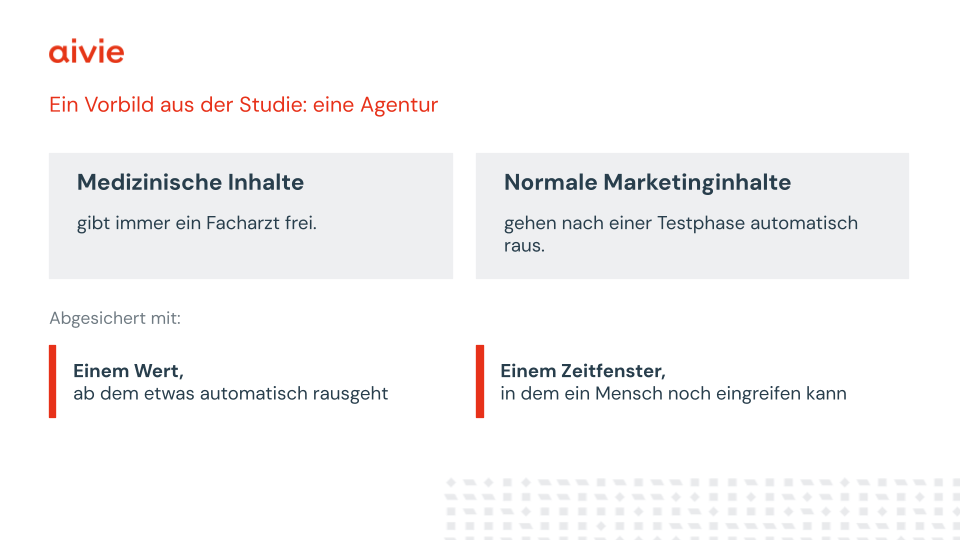
Another customer, an agency, also works with medical content. This must always be approved by a specialist doctor. Normal marketing content, on the other hand, is published automatically after a test phase. This is secured with a value above which something is sent automatically, and with a time window in which a human can still intervene. The study sees this as a useful model.
I can relate to that. The messages that go out must remain under control for me too. I don’t want to promise anything that isn’t true. And I don’t want to trigger problems that I have to deal with the consequences of later. At the same time, it’s not possible to check everything individually. An approval every two seconds? Nobody can do that.
That’s why I believe in a smart middle ground: enough control without an unnecessary amount of work. The agency’s model is a good example of this for me.
What staged approval can look like
From what the companies said, a kind of staircase emerges:
- The AI decides for itself. Low risk, many contacts, for example, a note about a new blog article.
- The AI decides with a time window. You can still intervene before something goes out.
- The AI suggests, you approve.
- A human always checks. For expensive, sensitive, or regulated offers, someone always looks closely.
I could well imagine a solution of this kind. The important thing is: you decide what runs at which stage. Not the AI. We described how you determine what agentic AI is allowed to see and do in “Marketing wants to build, Legal slows things down”. How do you see it? Write to me with your view, I’m curious.
Insight 4: It doesn’t have to be in real-time
There was no clear desire for real-time. One company deliberately does not react to every single click. It waits until a pattern emerges. This fits better with its calm style of communicating with customers. And another says: feel free to give the system time to collect more signals.
At the beginning, however, you want to know exactly. Someone said about approval:
“Yes, of course. I want to learn. I want to see it.”
So: first approve it yourself and then let go more step by step.
Our pilot
What the study gives us for our pilot AI:
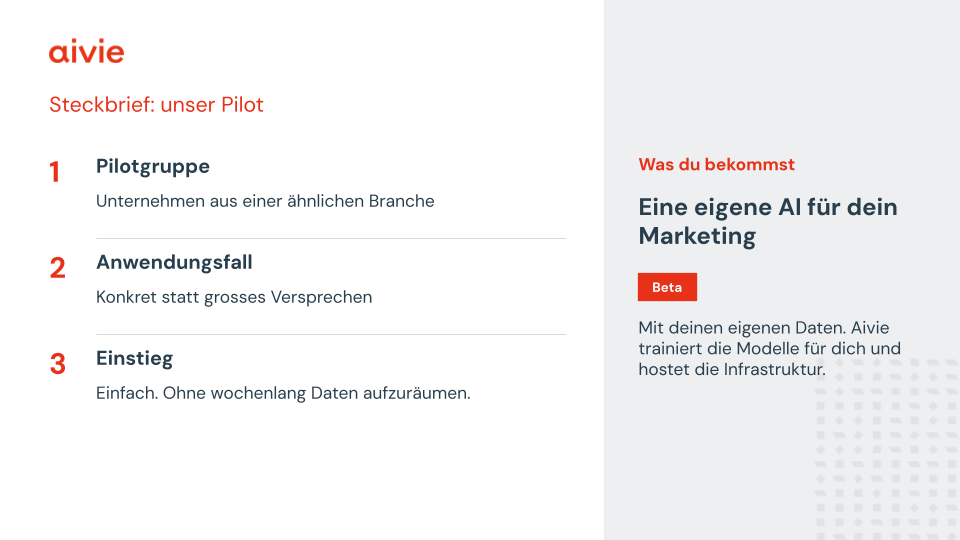
- The companies in a pilot group should come from a similar industry. Otherwise, the results mean very little.
- Companies want to see a concrete use case, not a big promise.
- The entry must be easy. Small teams don’t have time to clean up data for weeks.
The pilot companies get their own AI for their marketing, with their own data. Aivie trains the models and hosts the infrastructure. We are currently testing the first use cases live, evaluating what works, and collecting further use cases with additional pilot companies.
Join us
For our pilot, we are still looking for more SMEs who want to try exactly this, with their own AI and their own data. Do you want to help shape it? Then write to me or book a call directly.
And if you want to know why I always ask “Whose AI?” when it comes to AI, read on: Your data is your treasure. Don’t just give it to the AI.
All beginnings are easy
Whether you’re a marketing manager, CMO, CTO, CEO, founder or simply curious: we will discuss your individual case in a 30-minute online appointment.
Using a comparable customer use case, we will show you how marketing automation can be applied in your business.
The appointment is free of charge.
