• Adrian Schimpf

    Adrian Schimpf ist CEO und Head of Product von Aivie, dem Marketing Automation Tool aus der Schweiz für Europa. Hier gestaltet er digitale Kanäle und Kundeninteraktionen mit Automatisierung, AI und Plugins. Zudem ist er Trainer bei LinkedIn Learning

    Er hat 20 Jahre Erfahrung an der Schnittstelle Kunde und IT. Zuletzt als Produktmanager bei der Swisscom, zuvor in verschiedenen Rollen bei KMUs, Startups und Agenturen. U.a. Software Entwickler, User Experience Consultant, Projektleiter.

Schedule a meeting

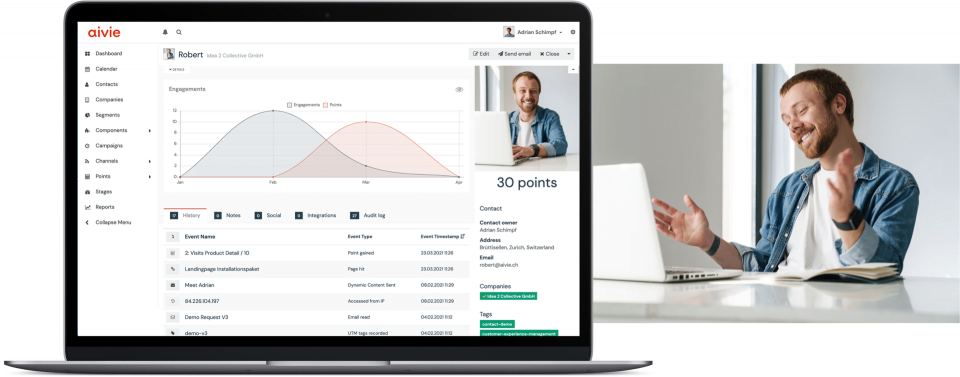
Mein Favorit in Aivie ist das vielfältige Lead Scoring
aivie marketing automation alexandra lead history 1920w

Sharing is Caring

This is how marketing automation works.

Marketing Automation - Basics

In this LinkedIn Learning course, we'll go step-by-step through designing and implementing your first campaign automation campaign.

Data protection check questionnaire

Privacy Questionnaire

Fill out our questionnaire and find out directly with the data protection check how your data protection is.

Strategy: Marketing Automation Canvas

Aivie Marketing Automation Canvas

Develop a strategy and a concept for your marketing automation. Here you can get the instructions and the canvas to fill out.

Marketing Automation Tool Evaluation
Value and evaluate marketing automation tools with our value analysis. You can download the value analysis here.

Posts

Why everyone is raising prices in 2026—and how open-source marketing automation changes the equation

2026 is the year of pricing rounds. Almost every major marketing tool has raised prices, reshuffled packages, or cut discounts. For many SMEs, that means the next invoice will be higher—often for features they don’t even use. So it’s worth looking at why prices rise in the first place. And why it can be done differently.

Read more: Why everyone is raising prices in 2026—and how open-source marketing automation changes the equation

Price increases as a deliberate strategy

Software gets more expensive over the years—no surprise there. What’s more interesting is the pattern behind it: with classic proprietary platforms, price increases are part of the business model. Growth doesn’t come only from new customers, but also from existing customers paying more over time. That makes business sense, but it also means your price goes up—regardless of whether your marketing actually needs more resources.

The three typical pricing levers of proprietary platforms

If you understand which screws are being turned, you make better decisions. In practice, it’s usually three levers:

– Seats (per user): Every additional colleague with access costs extra. Your team grows, the invoice grows with it—even if marketing activity stays the same.

– Feature packages: Key features sit in the next tier up. You buy a whole bundle just to get one function.

– Pricing rounds and bundles: Annual adjustments or new package structures you automatically get moved into.

The common denominator: none of these levers is directly tied to your benefit. You pay for the model, not for what you actually consume.

The only honest cost driver: the size of your database

There’s one cost driver that truly has to do with operations: the number of your contacts. Every contact means storage, processing, and delivery. More contacts mean a larger database, more compute load, and more infrastructure. These costs are real—and they rise predictably as you grow.

Why Aivie bills per contact

Aivie also bills per contact. But not as a pricing trick—rather as a transparent proxy for these very real infrastructure costs. The benefit for you: the price is predictable. You choose your contact tier, you know your costs, and you can increase or reduce the number of contacts at any time. A reduction takes effect in the next billing period.

Felix - Customer Case Ferris Ai

“We wanted to design the entire invitation process with a high degree of automation but the highest possible level of customization. After all, we want our guests to be well picked up and simply look forward to the event.”

Bryan Graf, KENDRIS AG

Just as important is what extra costs don’t apply with Aivie. There are no setup fees, no per-user price—your whole team can work with it without the invoice going up—and the full feature set is already included in the base setup, not hidden behind tiers. For longer terms, there’s a discount (currently up to 3 years possible). You can calculate your exact price for your number of contacts directly at aivie.ch/preise-pakete.

And if you need more: expand instead of switching

The full feature set is included in the base setup—but not every need fits into a standard package. For anything beyond that, there are add-ons that aren’t included in the base price. You only add them when you truly need them. That keeps your base price predictable, and you expand your setup deliberately instead of sliding into the next tier. So you still only pay for what you actually use—core and add-ons alike.

What open source changes on top of that

Price is only part of the equation. Aivie is built on Mautic, the world’s only open-source marketing automation platform. That means full data sovereignty, no lock-in, and open interfaces via REST and JavaScript APIs, plus your own plugins. You can take your setup with you at any time, build (or have built) your own functions, and integrate deeply into existing systems.

YouTube Thumbnail

We host sensitive customer data encrypted on certified servers in Switzerland, Germany, or a location of your choice: ISO 27001, FINMA, and compliant with the Swiss Data Protection Act (revDSG) and GDPR.

And because Aivie takes care of operations, updates, support, and services, you get the freedom of open source without having to carry the technical effort yourself—and without giving up convenience.

Conclusion

Prices for marketing tools will keep rising. The real question is what you’re paying for. For a pricing model with seats, packages, and pricing rounds? Or for real costs you can understand and plan? Open source and a contact-based model make the equation transparent, give you flexibility, and put you back in control of your data.

All beginnings are easy

Whether you’re a marketing manager, CMO, CTO, CEO, founder or simply curious: we will discuss your individual case in a 30-minute online appointment.

Using a comparable customer use case, we will show you how marketing automation can be applied in your business.

The appointment is free of charge.

Find out how your case can be implemented

What Open Source software Mautic taught me over 9 years

Nine years ago, I set up an open-source tool for the first time: Mautic. I was sitting at my computer at night working on it—alongside my day job. My goal: I wanted marketing automation that wouldn’t take control of my customer data out of my hands. Today, my entire company is built on it.

Time for an honest assessment: these are the five most important lessons I’ve taken away for myself over these nine years. And honestly: I wish I’d known them earlier.

Read more: What Open Source software Mautic taught me over 9 years

How it all started

In 2017, I was co-founder and CTO of a small software startup. We had a good product, but no budget for expensive marketing suites. Above all, we had no desire to hand our customer data over to an American cloud provider.

While looking for a solution, I came across Mautic: the first open-source platform for marketing automation. It was launched in 2014 by David Hurley with the idea “made by the people, for the people.”

As someone who’s been developing software for more than two decades, one thing was clear to me: I want a tool I can customize and extend myself. That’s how Aivie came about: part of the Mautic community since 2019, a partner since 2020, and since 2025 I’ve been part of the Mautic Council.

Lesson 1: Email marketing is much more complicated than it looks

What I massively underestimated is how complex email marketing is. First, the tech: reliably getting an email into the inbox is anything but trivial. Deliverability, sender reputation, warmed-up sending IPs, correctly set up authentication with SPF, DKIM, and DMARC all matter. Most of it is invisible—until it doesn’t work properly.

What customers who have switched to Aivie say

We moved from HubSpot and now have lower costs, less effort and, with Aivie, a partner that doesn’t hide its services behind a paywall. We also appreciate the excellent support.

Daniel B.
IT

Both the tool and the service are excellent. I particularly appreciate the fast response and data security, as all data is stored in Switzerland. The prices are very reasonable. Would recommend this service to others!

Hannes B.
CEO

We have been working with Aivie as a marketing automation service for years. It is the clear number one in the areas of marketing automation and marketing strategy, and also offers by far the best price-performance ratio!

Felix C.
CMO

Then there’s the legal side: consent, double opt-in, traceability, deletion concepts—with GDPR and revFADP, that’s not optional, it’s a basic requirement. And finally the hardest part: people. You can do everything right technically and legally. But if your recipients don’t see the value, even the best automation is useless. Relevance beats reach, every time.

Lesson 2: Data sovereignty used to be a niche. Today it’s a CEO-level topic

When I started arguing “your data belongs to you” in 2017, many people gave me a friendly smile. Today, that same question plays a central role in almost every first conversation—whether it’s coming from management, legal, or procurement.

The context has changed: the revised Swiss data protection law, GDPR, and a broad debate about digital sovereignty, where even authorities and armies are now questioning their cloud dependencies (the Swiss Army, for example, is increasingly relying on European software instead of Microsoft).

For us, data sovereignty means something very concrete: the data is stored encrypted on a Swiss server—if you want, entirely on Swiss infrastructure, in your own instance. You can find out more in the post on the new data protection law and on Mautic hosting.

Lesson 3: An honest price is one you understand

Over the years, I’ve seen countless tool invoices. What stuck with me: the problem is rarely the price level—it’s when you can no longer explain what you’re paying for. In marketing automation, there’s exactly one honest cost driver: the size of your database. Every active contact means storage, processing, and delivery. That’s why almost everyone charges by contacts—and so do we.

The difference isn’t whether you charge, but whether the price only goes up where real costs arise. For us, the per-contact price is a transparent proxy for infrastructure costs—no per-seat markup, no features hidden behind the next tier, no annual price hike. A price you can explain to your CFO in two minutes is worth more than a low entry price nobody can verify.

Lesson 4: Open Source isn’t free—it’s shared

At first, I thought open source mainly meant “free.” Wrong—it means “shared.” Mautic is supported by a global community of countless volunteer contributors and is used in tens of thousands of organizations. That breadth is the real protection: no single vendor can change the terms overnight, triple the price, or discontinue the product. But a community is not a self-serve buffet—if you only take, you’re sawing off the branch you’re sitting on.

1 1

That’s why we give back: a new email builder, ongoing improvements to Mautic, currently the Head of Product, and our special Aivie plug-ins for the community—free of charge or for a small contribution to cover costs. In the end, everyone benefits, worldwide.

Lesson 5: Most of the time it doesn’t fail because of the tool. But sometimes it does

The vast majority of marketing automation projects don’t fail because of the tool, but because of everything around it: lack of time, unclear processes, content that never gets written, and the expectation that a tool replaces strategy. The tool is usually the easy part.

But sometimes it does fail because of the tool—in two ways. First, the costs: if the price rises disproportionately with every thousandth contact, every good idea eventually becomes too expensive.

Second, technical hurdles: a missing integration, a feature behind a paywall, a system you can’t cleanly get your data out of. That’s exactly why the choice of tool does matter. What counts are predictable costs instead of an invoice that punishes your growth, and open technology instead of a wall where your ideas stop.

Conclusion

Nine years, five lessons: Email marketing is more complicated than it looks. Data sovereignty has become a CEO-level topic. An honest price is one you understand. Open source is shared, not free. And in the end, it’s not the tool that decides, but the process behind it—unless the wrong tool gets in your way with costs and technical limits.

Would I do it the same way again? Yes, absolutely. Even again at night, alongside my job, with a broken first installation. Exactly like that. If you want to know what an open, sovereign setup looks like today, you’ll find an overview at aivie.ch.

Marketing automation that simply works

Woman sees how easy marketing automation is with Aivie

Start immediately with the right use case package from Aivie

Whether it’s winning leads, creating customer loyalty or implementing data protection securely – with our preconfigured use case packages, you can get your marketing automation up and running quickly and effectively. Without lengthy training. Without detours. Select a package, simply get started and see the results.

Get started now

A newsletter from just one photo: How effectively AI works at Aivie

Just a few minutes, and I’m sitting in front of my finished newsletter. All I needed for it? A single photo. I chose a picture I had taken earlier with the team at the lake. Done. No hours of tinkering with templates, no copy-pasting from old mailings. A short prompt, the image to go with it, and the AI took care of the rest for Aivie.

Sounds like a gimmick? Understandable. But behind it lies a lot of work relief. It’s a small, concrete glimpse into a much larger idea of how AI and marketing automation belong together. I’ve summarized the whole thing in a demo.

Read more: A newsletter from just one photo: How effectively AI works at Aivie

Demo: How the AI at Aivie works

I gave the AI a short prompt and selected the photo from the “day at the lake.” After that, the following happened practically by itself:

  • Aivie accesses your instance directly and picks a suitable newsletter template from the stored templates.
  • Because it’s Aivie, the tool already knows your context: logo, address, colors, and even your writing style.
  • It also knows your segments—in other words, who the email should actually go to.
  • The selected image is automatically uploaded to the Aivie media library and placed in the layout.

After an initial run, I had the email revised one more time: logo in the right place, personalized signature at the end. Finally, I added a call-to-action from the reusable components: dynamic content that automatically shows each recipient the account manager responsible for them. In just a few minutes, a photo became a ready-to-send, personalized email.

YouTube Thumbnail 2

One detail that’s important to me: I used ChatGPT for the text generation here, but the AI model is interchangeable. The same thing works with Claude, Gemini, or another provider of your choice. Aivie is the layer on top that knows your context and keeps you in control.

Why this is more than just “AI writing texts”

Most AI functions in marketing stop at copywriting. Our vision deliberately goes further. AI shouldn’t just generate content; it should understand marketing processes and goals and provide strategic support.

In the longer term, for us, this means: analyzing and interpreting data, recognizing patterns, suggesting optimization potential, and thinking along as a marketing automation assistant. Not just executing, but advising. Not just generating content, but improving performance.

This is exactly where the connection between AI and marketing automation happens: real AI process automation that doesn’t replace marketing teams, but strengthens them strategically.

Why this isn’t a contradiction to data protection

When using AI in marketing, people often unintentionally give up control, often over marketing data: to a black box, to a single provider, to an infrastructure. Aivie deliberately pursues a sovereign approach.

  • No black box and no uncontrolled data transfer.
  • No dependency on a single AI provider – the model is selectable.
  • Full control over data and infrastructure, based on open source (Mautic) with your own instance.
  • Your personal data is stored encrypted on a Swiss server, revDSG-compliant. Upon request, we offer complete hosting on Swiss infrastructure.

This is crucial, especially for SMEs that want to use AI without giving their data away.

Swiss software with AI

Aivie carries the labels “swiss made software + AI” and “swiss digital services + AI” (more on this at swissmadesoftware.org). Another label – Swiss Hosting – will be added soon.

Testimonial Alexandra

“We need Aivie especially for our blog newsletter. And there it’s mega cool to see which person has read what.”

“Our blog newsletter is our most important touchpoint. We are mega happy that the implementation of the RSS feed in the newsletter worked so well and that we can now send our blogs automatically.”

Alexandra Scherrer, Carpathia

Currently, we are showing what is possible with large language models (LLMs). But the goal goes further: every company should be able to integrate its own LLM or use the upcoming Aivie LLM. So you don’t have to worry about your data. It’s with Aivie, and it’s safe here.

Try marketing automation with AI for yourself

We’d love to show you live how this looks with your templates, your context, and your segments. Book a tool demo or see how you can create emails directly with AI in Aivie.

And if you generally want to move away from the “newsletter for everyone”: here we explain how to get from newsletters to nurturing campaigns.

Switzerland kicks Microsoft out and now relies on open source

In Switzerland, the topic of digital sovereignty is moving further into the political spotlight this year. At the beginning of July, the Canton of Geneva became the first canton ever to adopt an official digital sovereignty strategy. On the same day, it became known that the Confederation’s cyber specialists are deliberately seeking distance from Microsoft. The City of Zurich is testing “openDesk”, an open-source alternative to Microsoft 365, and in Germany the federal government and the states decided with the “Germany Stack” to make open file formats mandatory from 2028.

The driving force behind it: cutting costs and regaining control. The Confederation and the cantons have spent over 1.1 billion Swiss francs on Microsoft licences over the past ten years. In the City of Zurich, Microsoft costs have quadrupled in just seven years. And with the revised Data Protection Act (revDSG), the question of where data is stored and who can access it is no longer a gut feeling—it’s compliance.

Read more: Switzerland kicks Microsoft out and now relies on open source

The blind spot: customer data

What has barely featured in the whole debate so far: it revolves almost exclusively around individual tools—Office, email, cloud storage. But an organisation’s most sensitive data isn’t Word documents. It’s people data: Who are my contacts, how do they behave, what are they interested in, what have they requested or bought? This data sits in marketing: in newsletter tools, in the CRM, in marketing automation.

But most SMEs and organisations outsource this sensitive customer data to US corporations like Mailchimp, HubSpot or Salesforce—everything stored in US clouds. This leads to a paradoxical situation: you migrate Office away from Microsoft to become more sovereign, while at the same time you keep sending the profiles of your own clients to a US corporation. That’s the blind spot.

With the revDSG, this becomes a concrete risk. For particularly sensitive data, fines of up to CHF 250,000 can be imposed—against the responsible person.

What customers who have switched to Aivie say

We moved from HubSpot and now have lower costs, less effort and, with Aivie, a partner that doesn’t hide its services behind a paywall. We also appreciate the excellent support.

Daniel B.
IT

Both the tool and the service are excellent. I particularly appreciate the fast response and data security, as all data is stored in Switzerland. The prices are very reasonable. Would recommend this service to others!

Hannes B.
CEO

We have been working with Aivie as a marketing automation service for years. It is the clear number one in the areas of marketing automation and marketing strategy, and also offers by far the best price-performance ratio!

Felix C.
CMO

Why municipalities are particularly affected

Nowhere is this as tangible as at municipal level. It’s not just the Confederation: the municipality of Volketswil has already switched to a purely Swiss alternative to Microsoft 365. Lenzburg has publicly named Microsoft dependency as a challenge. The new centre “Sovereign Digital Switzerland” explicitly targets all levels of government: the Confederation, cantons and municipalities.

Municipalities communicate constantly: newsletters to residents, event registrations, information on votes, place marketing, tourism, club announcements. At its core, that’s marketing automation—they just don’t call it that in public administration. The data behind it is particularly sensitive, though. It’s the data of their own citizens.

For a municipality, it’s hard to justify writing to residents via a US newsletter provider while switching Office for sovereignty reasons.

The feasible path

This is exactly where open-source marketing automation is the solution. At Aivie, it’s based on Mautic—an open, established platform we’ve been working with for eight years. The principle: your own instance, full data control, and the data stays in Switzerland.

By default, it’s stored encrypted on a Swiss server, compliant with the revDSG. If you want maximum sovereignty, there’s also the option of full hosting on Swiss infrastructure.

1

With both options, you avoid what comes with US clouds: a newsletter tool that quietly monetises contact profiles in the background, and vendor lock-in with annual price jumps—like Mailchimp is demonstrating once again.

Even so, it includes everything a modern marketing tool needs to do: newsletters, automations, segmentation, forms, campaigns.

The key difference from the big public-sector migration: for an SME or a municipality, this isn’t a century-long project—it can be implemented in weeks. Sovereignty is no longer a multi-million question. It’s a fundamental decision.

All beginnings are easy

Whether you’re a marketing manager, CMO, CTO, CEO, founder or simply curious: we will discuss your individual case in a 30-minute online appointment.

Using a comparable customer use case, we will show you how marketing automation can be applied in your business.

The appointment is free of charge.

Find out how your case can be implemented

Automate Material Compliance: How Studer Cables Efficiently Digitalizes Supplier Processes

Material compliance is essential, but often time-consuming. With Aivie, Studer Cables saves several days of work per cycle in the compliance process. Studer Cables faced the challenge of regularly and verifiably checking hundreds of materials, numerous suppliers, and various products for compliance. We successfully optimized this.

Continue reading “Automate Material Compliance: How Studer Cables Efficiently Digitalizes Supplier Processes”

Complaint Management Marketing – How can I monitor the complaint rate?


In email marketing, trust is crucial. As soon as your recipients start marking emails as spam, not only does your deliverability suffer, but your brand image can also be damaged in the long term. That’s why complaint management in marketing is one of the central tasks of any professional marketing strategy.

What does “complaint rate” mean in email marketing?

The complaint rate (also “Spam Complaint Rate”) indicates how many of your recipients mark your emails as spam. This rate is given as a percentage and is a key indicator of the reputation of your sender domain.

The higher your complaint rate, the more likely it is that:

  • your emails will end up in the spam folder,
  • you will get on blacklists,
  • your email tool will restrict or block you.

Why is monitoring the complaint rate so important?

If you regularly send mass emails – e.g. newsletters, campaigns or automation sequences – a low complaint rate is essential. It shows that your content is relevant, your target group has been cleanly segmented and you are maintaining a healthy recipient list.

Even small fluctuations can affect your overall deliverability.

How can you monitor the complaint rate?

Central monitoring tools are the Google Postmaster Tools.

With the Google Postmaster Tools you can:

  • view the spam complaint rates of your Gmail recipients,
  • monitor your domain reputation,
  • identify technical sources of error (e.g. authentication problems),
  • analyze trends over several weeks.

Google benchmark: The spam complaint rate should remain below 0.1%. For example, if you send 10,000 emails, no more than 10 recipients should report your message as spam.

Important to know: Even if you have recipients outside of Gmail, the figures from the Google Postmaster Tools are a valuable benchmark. Because other providers such as GMX, Outlook & Co. rarely disclose comparable data.

How can you actively avoid complaints?

It can never be 100% guaranteed that an email will not end up in spam or will not be marked as spam by the recipients. Nevertheless, the following important points should be observed in order to avoid complaint management in marketing as much as possible.

  1. Use double opt-in: Make sure that your recipients have explicitly agreed to receive your emails.
  2. Segmentation & relevance: Only send what is appropriate for the target group. Avoid irrelevant content or too high a sending frequency.
  3. Make the unsubscribe link clearly visible: A clear “Unsubscribe” button prevents annoyed recipients from reporting you as spam.
  4. Secure the technical basis: Aivie, for example, automatically ensures the correct setup of SPF, DKIM and DMARC – important prerequisites for delivery.
  5. Regular list maintenance: Remove inactive contacts. Fewer recipients, but interested ones, bring more success.

Read more exciting information about spam in email marketing here.

Conclusion: Complaint management is email marketing protection

A low complaint rate is a seal of approval for good marketing. Anyone who ignores complaints not only risks technical problems, but also actively damages the reputation of the company. Tools like the Google Postmaster Tools help you to keep track and take targeted countermeasures.

With Aivie, you have a marketing automation tool that not only focuses on segmentation and personalization, but also takes all technical precautions to ensure that your emails safely land in the inbox of your recipients.

Talk to us – we’ll help you take your complaint management in marketing to the next level.

Stop sending newsletters: start running campaigns

From old-school newsletters to nurturing campaigns

Are you still sending impersonal newsletters to the masses? Then this post is your motivation boost to finally unlock the potential of email marketing. Because email marketing still has a high Return on Investment (ROI). We’ll show you how to use newsletters as a targeted marketing tool. So, ditch the old school newsletter and start designing campaigns with us.

Continue reading “Stop sending newsletters: start running campaigns”

Swiss email builder in use worldwide: Insights into the open source community

Media release from September 2021

Adrian Schimpf from Aivie is part of the Open Source Community Mautic. Mautic is a marketing automation technology. Adrian Schimpf has been working intensively on a new email builder for Mautic in recent months – and has donated the code to the community so that Mautic users worldwide can benefit from it. The technology is used in 188 countries and is available in 35 languages – this now also applies to the new email builder Made in Switzerland.

Continue reading “Swiss email builder in use worldwide: Insights into the open source community”

Marketing Automation in a Crisis – Why Now is the Right Time

Marketing Automation – If Not Now, When?


Marketing Automation is not a new concept – but its relevance has never been as high as it is today. While many companies in Switzerland and worldwide hesitate in the face of economic uncertainty, this very hesitation represents a missed opportunity.

Because: Crises are not only times of saving, but also of strategic reorientation.

Continue reading “Marketing Automation in a Crisis – Why Now is the Right Time”

Use a betting game as a lead magnet

A sweepstake is a creative way to generate leads, qualify potential customers, build trust and boost conversion rates – and it’s fun! However, developing a successful sweepstake requires strategy and careful implementation. In this blog, you will learn how to use a competition, in this case the summer betting game, as an effective lead magnet.

Continue reading “Use a betting game as a lead magnet”

Several thousand francs turnover with existing hotel guests – Marketing Automation Case

Our customer Riva Rooms & Studios is an automated smart hotel in Locarno. With the help of Aivie, they are now also able to attract guests in a timely manner. By successfully setting up an automated newsletter campaign, bookings of several thousand francs have already been achieved by existing guests. This is despite 2024 being a very difficult year for Ticino. Aivie also proved its worth when the storms led to a large number of cancellations and prevented the worst from happening.

Continue reading “Several thousand francs turnover with existing hotel guests – Marketing Automation Case”

Why Aivie relies on marketing automation with Mautic: a look behind the scenes

In 2017, as the founder and CTO of Smolio, I was looking for a solution to automate our sales funnel. In this context, I got to know and love the Mautic Marketing Automation platform. And later founded Aivie to make its advantages easily accessible to other companies.

Continue reading “Why Aivie relies on marketing automation with Mautic: a look behind the scenes”

How do emails not end up in spam?

I’ve been hearing this question a lot from our customers recently: What do I have to do so that my e-mails don’t end up in spam? There are various points to consider. On the one hand technically, on the other hand also in preparing and creating the e-mail. In the following, I will go into the individual points, explain what you need to consider and how Aivie supports you so that your emails don’t end up in spam.

Continue reading “How do emails not end up in spam?”

Augmented reality as an established marketing tool

Over 50% of all Swiss citizens have already used augmented reality applications. The potential is enormous and the possibilities almost unlimited. With the announcement of Apple’s mixed reality glasses a few days ago, one thing is clear: augmented reality is now part of every marketing mix, but it’s no longer rocket science.

Continue reading “Augmented reality as an established marketing tool”

Send blogs automatically via newsletter

Are you looking for a simple and effective way to automatically send your blog posts to your subscribers via a newsletter? Then Aivie and RSS feeds are the perfect solution!

With Aivie and an RSS feed, you can import the latest blogs into your emails and deliver them to your readers’ inboxes. You can do a combination of editorial and automated parts, or automate the newsletter completely.

Continue reading “Send blogs automatically via newsletter”

Marketing automation with social media marketing

Would you like to successfully collect contacts via Google and social media? And then address them again when your channels are exhausted? With the integration of adhook and Aivie, this is possible – completely automatically! With adhook, you can plan, analyze, optimize and moderate posts and ads campaigns and coordinate collaboration across teams. In Aivie, you store and evaluate the data from all channels and the entire customer journey. Marketing automation with social media marketing plays out even more precise and therefore more efficient campaigns along the entire customer journey.

Continue reading “Marketing automation with social media marketing”

TAWNY analyzes videos with emotional artificial intelligence

Recognizing and measuring emotions has long been the subject of scientific research. They play a central role in market and consumer research in particular. Why is that the case? Emotions are at the heart of human experience. Emotions control our social behavior, they determine our decision-making and thus have a major influence on our daily lives. We explain how Emotion AI, emotional artificial intelligence, works and how TAWNY tests videos with Emotion AI.

Continue reading “TAWNY analyzes videos with emotional artificial intelligence”

Building relationships with funnels and marketing automation using the example of Tinder Thomas

Maybe you know someone like Thomas. Thomas is actually quite nice and we would actually recommend him to all our single women. But it doesn’t really have to be right for a relationship. We took a strategic look with Thomas at how he can build a relationship. From the strategy, the funnel, the tactics, the campaigns, to the individual offers and goals for each phase. And lo and behold, it works. Along the marketing automation canvas, we show the funnel to build a relationship.

Continue reading “Building relationships with funnels and marketing automation using the example of Tinder Thomas”

Swiss marketing automation tool Aivie wants to outpace Mailchimp, HubSpot and Co.

Media release July 2021

Whether it’s a simple newsletter or a sophisticated multichannel campaign, the demands on marketing tools are high and companies are becoming more demanding, especially when it comes to handling data.

Data sovereignty becomes more important. Not only because of regulators. But also because of the realization that data is increasingly becoming the company’s real gold. At the same time, the handling of data should become easier. It is precisely this sweet spot that a Swiss company has taken advantage of and recently launched Aivie, a marketing automation tool that makes powerful technology easy and safe to use.

Continue reading “Swiss marketing automation tool Aivie wants to outpace Mailchimp, HubSpot and Co.”

Off to the golf course: Automated campaign for event

Our client KENDRIS is a successful trust company. KENDRIS relies on personal relationships and has high quality standards.

Once a year KENDRIS invites its valued customers to the golf course. The experience is important for relationship building. That’s why it’s also important that the surrounding area, i.e. the digital experience, reflects the high quality standards. Reliable, automated event communication ensures that no questions remain unanswered – from registration to directions.

Continue reading “Off to the golf course: Automated campaign for event”

How to find your Marketing Automation Tool?

6 criteria to evaluate your marketing automation tool

There are currently over 9,500 MarTech tools on the market. So, on an average day, we spend at least an hour gathering information from various tools. Many feel overwhelmed by the number of tools they interact with while working.

Therefore, it is essential to consciously choose the marketing automation tool we work with every day. Because the immense number of tools we interact with every day means that we often change context. This in turn influences our creativity and focus.

Continue reading “How to find your Marketing Automation Tool?”

Recognize intent and learn from touchpoints

Intents are the intentions behind the actions of users and customers. If we know the intention of a contact in a certain situation, in a certain context, we can address the contact with currently relevant content. Intent we recognize in the touchpoint, each touchpoint is thereby a learning opportunity. With marketing automation, suitable content is then placed – completely automatically.

We talked with Björn Nagelmann in #scxtalk about opportunities and the challenges of detecting intents in the context of marketing automation.

Continue reading “Recognize intent and learn from touchpoints”

Lead Scoring with Mautic optimizing sales funnels

Sooner or later the time comes when, with the resources available, the abundance of inquiries/contacts can no longer be dealt with in a reasonable time and with the necessary attention. At the latest now is the time to think about which of your contacts you want to focus on intensively / personally. Lead scoring helps to use the available resources efficiently and to optimize marketing funnels. In this article, we look at how lead scoring can be implemented quickly and easily with Mautic – and what has changed in the new topic-based lead scoring with the Aivie upgrade.

Continue reading “Lead Scoring with Mautic optimizing sales funnels”

How your website automatically wins 30 customer projects with Aivie

Our client Falcone Specialities is an international distributor of food ingredients and chemical specialties to the processing industry. The company has been in existence for 10 years and it has made a name for itself with high-quality raw materials. The project resulted in a new website with marketing automation that reflects high-quality standards. With marketing automation, the potential is exploited digitally, leads are generated and customers are processed via the new website.

Continue reading “How your website automatically wins 30 customer projects with Aivie”

Double Opt-In with Mautic

At the latest since the new European DSGVO came into force, every marketer has asked himself the question: “Single Opt-In vs. Double Opt-In. What is required to comply with DSGVO?”. Both have the advantages and disadvantages. However, especially for end-customer communication, Double Opt-In offers three major advantages for companies compared to Single Opt-In:

  1. Traceability of customer consent to receive marketing messages
  2. Improved reputation of the email sender
  3. Higher quality of the contact list and customer relations
Continue reading “Double Opt-In with Mautic”

Use content efficiently in automated funnels

Marketing automation is used to address customers and guide them automatically through a sales funnel. Every interaction must offer added value so that customers stick with it and take the next step. This applies to digital customer interactions as well as in-person ones. For this, we need the right content in the right place.

Continue reading “Use content efficiently in automated funnels”

5 tips for successful landing pages

Does this sound familiar to you? You have a lot of visitors on your website, but they leave only after a short time. You’ve put a lot of time and effort into your landing page, yet conversions are rare. Maybe it’s time to rethink your landing page. Our 5 tips for successful landing pages should help you.

Continue reading “5 tips for successful landing pages”

Aivie email template based on the leaked Amazon template and best practices

With an email template we can quickly and easily create an email. But what does a good email marketing template actually look like? Should it be more of a text email? Or would you prefer a colourful HTML e-mail?

Continue reading “Aivie email template based on the leaked Amazon template and best practices”

7 steps to secure Mautic hosting

Building and running a secure marketing automation infrastructure with Mautic can be difficult. We know this because we’ve spent years solving these problems for technology startups, SMBs, and large enterprises. Hackers are constantly on the lookout for companies to target. Achieve secure Mautic hosting with these 7 immediately actionable steps.

Continue reading “7 steps to secure Mautic hosting”