
On November 12, Microsoft 365 was disrupted for about a day. Outlook, the calendar in Teams, and Copilot went down simultaneously in many countries. A lot of people are now asking which provider to switch to. I think that’s the wrong question. The better one is: why does everything at your company depend on a single provider? The answer is an ecosystem of interchangeable building blocks that work together through open interfaces. In this article, I’ll explain why that’s more robust than any big platform, where the limits are, and four steps you can take right now.
Contents
- What happened in the Microsoft outage?
- Why does a single failure bring everything down?
- Speedboat instead of a tanker: why I rely on Best of Breed
- What does an ecosystem do differently?
- Does an ecosystem never fail? The honest downside
- What can you do now? Four steps
- Conclusion

What happened in the Microsoft outage?
The disruption began on Thursday, November 12, in the early evening our time. Many people could no longer access Outlook, and emails arrived late. After that, one service after another went down: the calendar in Teams, Copilot, parts of SharePoint, the admin portal, and even security features. External AI services also had trouble connecting to Microsoft 365. Reports came in from 74 countries.
Switzerland was right in the middle of it. Richemont couldn’t publish its half-year results as planned at 7 a.m. on Friday, and things weren’t running smoothly at SRF either. According to Inside IT, Zurich Insurance customers, for example, had to report urgent matters by phone.
A preliminary report from Microsoft is now available. The bug was in the servers that establish connections. What’s notable is how it spread: the system automatically checks the servers. If one fails, it’s taken offline. The remaining servers take over its workload, become overloaded, and fail themselves. Newly restarted servers failed again as soon as traffic came back. So the safety net actually made the outage worse.
It wasn’t an attack. Microsoft has apologized and announced further details. It also wasn’t the first major outage this year: there were bigger disruptions to Microsoft 365 back in January and at the end of August.
Why does a single failure bring everything down?
Why was the damage so extensive? Because with a single platform, everything hangs on the same backbone. For Microsoft 365, that’s Exchange, the mail system, among other things. If it goes down, you don’t just lose your emails. You also lose your calendar, because your appointments run through it. Copilot can no longer access your emails, your calendar, or your files. And you lose exactly the channel you’d use to inform your team.
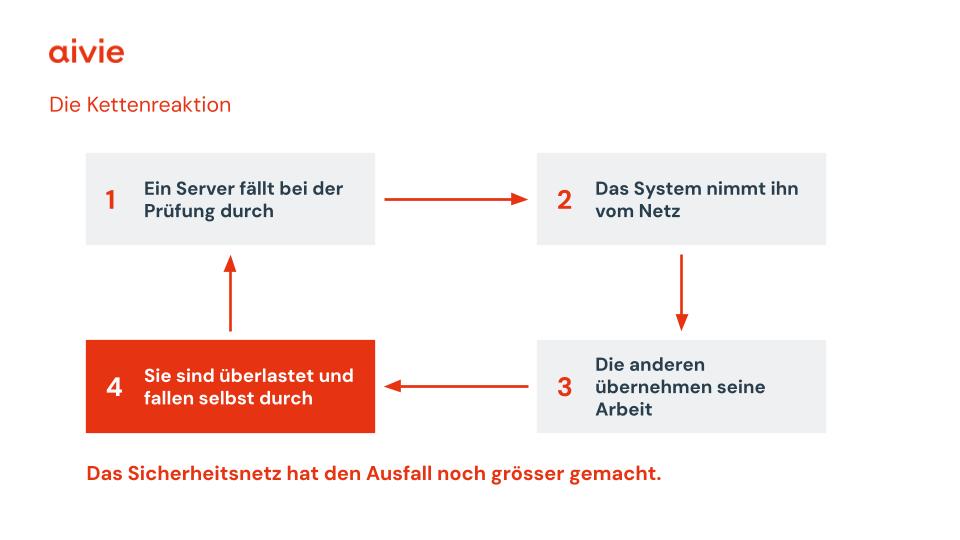
You could argue that Microsoft runs huge data centers all over the world. True. But the same software runs everywhere. More servers here just means more copies of the same thing. If the bug is in one copy, it’s in all of them. That’s why it spread everywhere so fast.
As a customer, all you can do in a moment like that is wait. You can’t speed anything up, and you don’t get a say.
Does Microsoft pay compensation?
In the contract, Microsoft promises that the service will run almost all the time. If that commitment isn’t met, you get a credit. But it only applies to the fee for the affected service, and your admin has to apply for it themselves (Microsoft Learn). It doesn’t cover the workday your team lost or the inquiry you missed.
Speedboat instead of a tanker: why I rely on Best of Breed
This topic matters to me for a personal reason. In 2017, I was the founder and CTO of Smolio. We wanted to automate our sales funnel, and my requirements were clear: the customer data had to stay in Switzerland. We wanted to retain control over our data and work with it flexibly. The price had to work for a start-up, and the solution had to integrate into our website and our app.
From the start, one thing mattered to me: Best of Breed. The best tool for each job, everything connected through open interfaces, not one big package for everything. That’s how I came across Mautic, an open-source software. Later, I turned it into Aivie so other companies could use Mautic easily too. How Smolio brought website and marketing automation together back then is shown in the Smolio case study. I tell the whole story in Why Mautic.
Behind this is an older experience of mine. I’ve seen companies cling to Lotus Notes for years. The system was deeply embedded in the business, and nothing could be swapped out. It took them about 20 years to switch, and innovation was barely possible the whole time.
I call this: speedboat instead of a tanker. A tanker is big and impressive, everything’s on board, everything comes from a single source. But it turns slowly, and it ties you down. The big platforms say: with us, everything fits together, it’s simpler. For me, that’s exactly where the danger lies. Because today, that advantage is small. Modern software is open, and interfaces let you connect tools quickly and easily. Last week showed us something else too: if the tanker runs into trouble, everyone’s in the same boat. A fleet of speedboats keeps going even if one breaks down.
What does an ecosystem do differently?
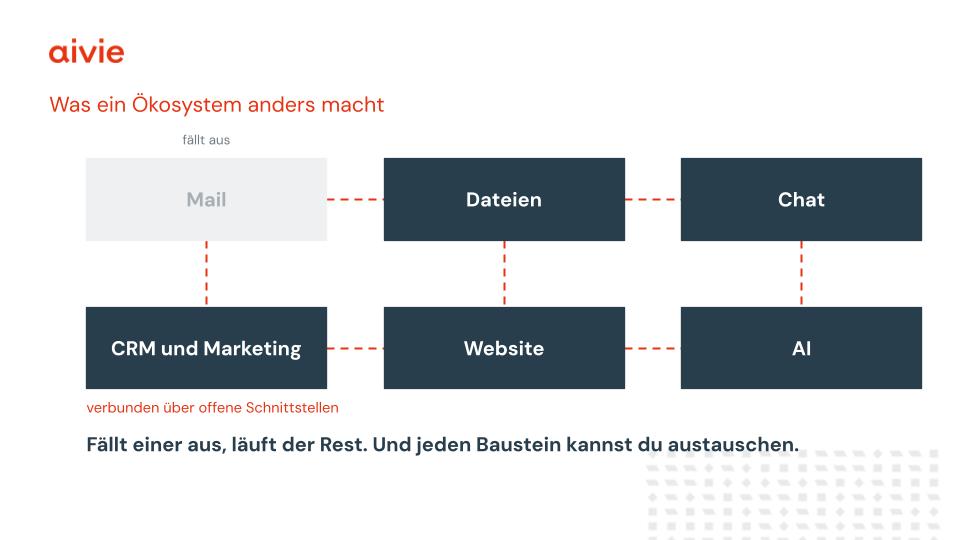
By ecosystem, I mean different building blocks, often from different providers, that work together through open standards. Each building block does one thing well, and you can swap out each one. That gives you two things:
- If one building block fails, the others keep running. If your email program has a problem, that doesn’t automatically bring your customer database to a halt, and neither does your website or your newsletter.
- You’re not locked in. If a building block no longer fits, you swap it out and leave the rest in place.
The federal government is building a fallback solution
This isn’t just theory. The Federal Chancellery is currently building a sovereign workplace, using open-source software for email, calendar, documents, telephony, and video calls. From the end of 2027, around 3,000 employees are expected to work with it — not instead of Microsoft 365, but alongside it, and also as a backup in case Microsoft 365 fails (Federal Council). In the test beforehand, the federal government combined open building blocks like Collabora, Open-Xchange, Nextcloud, and Element. I describe what that test showed in Open Source Works – the Hard Part Comes After.
Airbus decides based on the data
The private sector is heading the same way. Airbus is moving around 70 of its most important applications to the French cloud provider Scaleway, including systems for design, production, and CRM. This is to be completed by the end of 2028. The chief digital officer cites protection against a kill switch and foreign laws as the deciding factor (Reuters).
What’s interesting is that Airbus isn’t throwing everything out. For other tasks, Airbus keeps using Microsoft, Google, and Salesforce, deciding case by case how sensitive the data is. That’s exactly what Best of Breed means: mix and match. Use what you need and whatever best fits your needs. And connect it all through interfaces or AI.
Aivie is a building block too
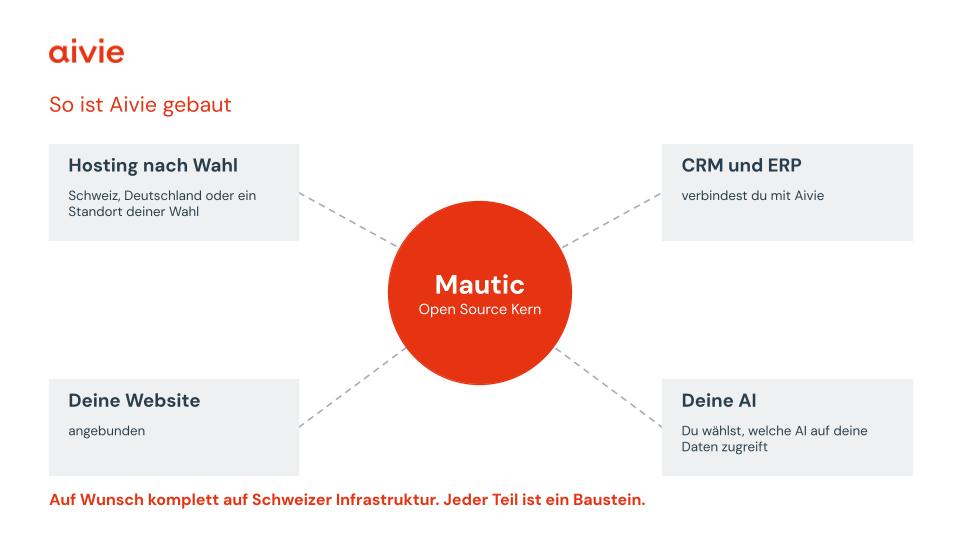
Aivie is built on the same principle. The core is Mautic, so it’s open source. Your data is stored encrypted, hosted in Switzerland, in Germany, or at a location of your choice — on request, entirely on Swiss infrastructure. You connect Aivie to your CRM, your ERP, and your website, and extend it with interfaces and plugins. Through our MCP interface, you choose yourself which AI gets access to your data. Every part is a building block you can keep or replace.
Does an ecosystem never fail? The honest downside
Does that mean an ecosystem never fails? No. I know this from my own experience: on October 21, I deliberately took Aivie offline. There was a critical security vulnerability in PHP affecting millions of websites. For me, that was a very uncomfortable day. A few things helped: every Aivie instance runs separately, email sending kept working, and the open-source community had a fix within hours. That’s exactly what makes an ecosystem for me: open software, separate building blocks, and decisions you make yourself. I describe how that day unfolded in The Day I Took Aivie Offline.
Switching isn’t automatic, either. In Denmark, the Ministry of Digital Affairs tested open-source office software (Cybernews). Employees complained about formatting and track changes, and the test was quietly ended in February. And the City of Zurich has classified a switch for its administration as unrealistic (blue News).
Two more points matter here. An ecosystem doesn’t mean no big providers. Airbus shows that, and we also use major cloud infrastructure ourselves. What matters is that you can swap it out. And more building blocks means more interfaces. These need to work well together, and someone has to manage that. That’s operations, and you can hand that off without giving up control.
What can you do now? Four steps
What does digital sovereignty actually mean for you right now? Here are four steps you can take immediately:
- Do the 24-hour test. Imagine your most important provider is gone for a day. What still works? How do you reach your team, and how do you reach your customers?
- Set up a contingency plan that doesn’t depend on the same platform.
- Start with your most valuable data: your customer data. Ask yourself three questions: Where is it stored? Who controls it? And how costly would it be to leave? I explain why these questions matter so much in Why You Shouldn’t Give Up Control of Your Customer Data.
- Take a close look at every new tool. Does it have open interfaces? Can you export your data cleanly? If you’re on open standards, you’re not stuck in a trap.
You don’t have to switch everything at once. Even the federal government is building its solution alongside Microsoft. Start with one building block.
Conclusion
Microsoft was down, and it’ll happen again: at Microsoft, at other big providers, and at ours too. The question isn’t whether a provider will go down. The question is whether that brings everything at your company to a halt. For me, digital sovereignty means: you can always choose, you can swap things out, and you can find another way. Speedboat instead of a tanker.
I’ll show you what our concrete, recommended ecosystem looks like in next week’s video. And if you want to know how your marketing can be a building block in an ecosystem like this, get in touch with me.
All beginnings are easy
Whether you’re a marketing manager, CMO, CTO, CEO, founder or simply curious: we will discuss your individual case in a 30-minute online appointment.
Using a comparable customer use case, we will show you how marketing automation can be applied in your business.
The appointment is free of charge.
