
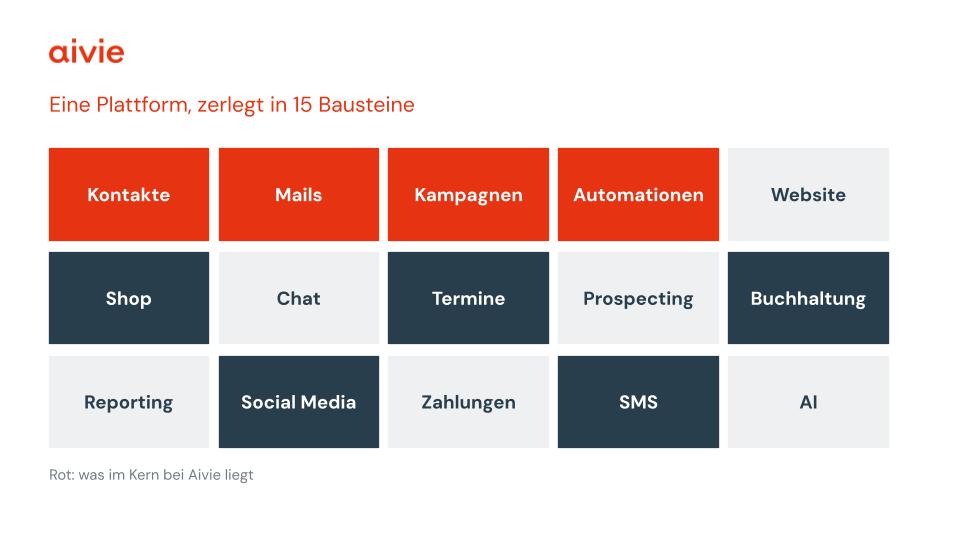
We broke an all-in-one platform like HubSpot down into 15 functional areas and filled each one with an open building block. We use this stack at Aivie ourselves, every day, and we recommend it to our customers. That sounds like freedom, and it is. But an open stack also has drawbacks. In this article, I’ll show you what you gain, where it gets tedious, and how we handle it.
Contents
- Toggle switch or mixing console?
- What does an open stack look like?
- What do you gain with an open stack?
- The honest drawbacks
- How we deal with the drawbacks
- My advice if you’re on a single platform today
- Conclusion
Toggle switch or mixing console?
In the article on the Microsoft outage, my argument was: you need an ecosystem instead of one big provider. A speedboat instead of a tanker. There, I promised to show our actual ecosystem. Here it is.
One sentence about it particularly resonates with me. Daniel Markwalder, responsible for digital transformation at the Swiss federal government, writes in Netzwoche: digital sovereignty isn’t a toggle switch, it’s a mixing console. So it’s not all or nothing. You decide block by block. That’s exactly how an open stack is built.
What does an open stack look like?
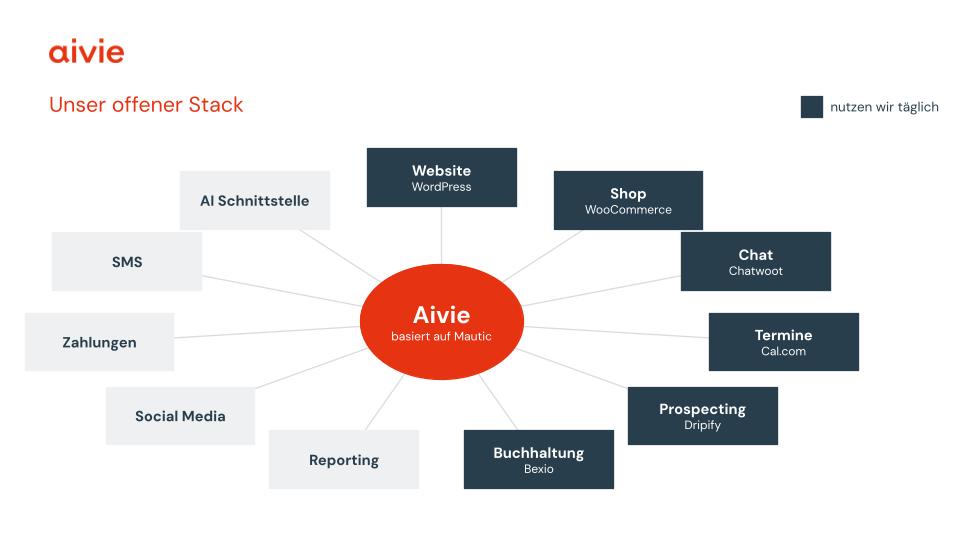
Aivie sits at the core. Aivie is based on Mautic, an open-source marketing automation software. That’s where your contacts, your emails, your campaigns, and your automations live. Around it hang the other building blocks: the website on WordPress, the shop on WooCommerce, the chat on the website with Chatwoot, appointments with Cal.com, LinkedIn prospecting with Dripify, and accounting with Bexio. Then there’s reporting, social media, payments, SMS, and an AI interface. You’ll find the complete overview of all 15 functional areas on the page Replacing HubSpot: open stack.
Eat your own dog food
The most important thing about it: this isn’t a stack we dreamed up for customers. It’s the stack we use ourselves. WordPress, WooCommerce, and Bexio are in use at our company every day, as are Cal.com, Dripify, and Chatwoot.
So we don’t just test the integrations once before launch — we test them daily, because our own business runs on them. This shows that it works and that the pieces fit together well. And where they don’t fit together well, we’re the first to notice and we improve it.
What do you gain with an open stack?
- You can swap things out. Each building block does one thing well. If one no longer fits, you replace it and leave the rest in place. You don’t have to rebuild your entire marketing setup just because one part no longer works for you.
- You’re more resilient. If one building block fails, the others keep running. With a single platform, everything hangs by the same thread — the Microsoft outage showed that.
- You decide where your data lives. For me, that’s the most important point.
Core data stays under your control
We follow one rule: the core data always stays with Aivie and under the customer’s control. That means contacts, their consents, and their history with your company. For the other building blocks, we weigh things up based on the business model, regulatory requirements, and also price. Not every building block needs to be maximally strict.
Some customers do want maximum strictness, though. Threema, for example, wants it to be impossible for any US company to access customer data at all. For them, we built such a strict setup that even the load balancer and the web application firewall run in Switzerland — including the parts that distribute traffic and fend off attacks.
Why location alone isn’t enough
Under the American CLOUD Act, US authorities can, under certain conditions, demand data from US companies even if that data sits in a data center in Zurich. So what matters isn’t just where the server is located, but also who operates it and which legal jurisdiction that company falls under. In an open stack, you can decide this block by block. That’s the mixing console.
The honest drawbacks
For me, an open stack has almost nothing but advantages, with one big exception: you have to look after it. That shows up in three places.
1. Not every provider plays along
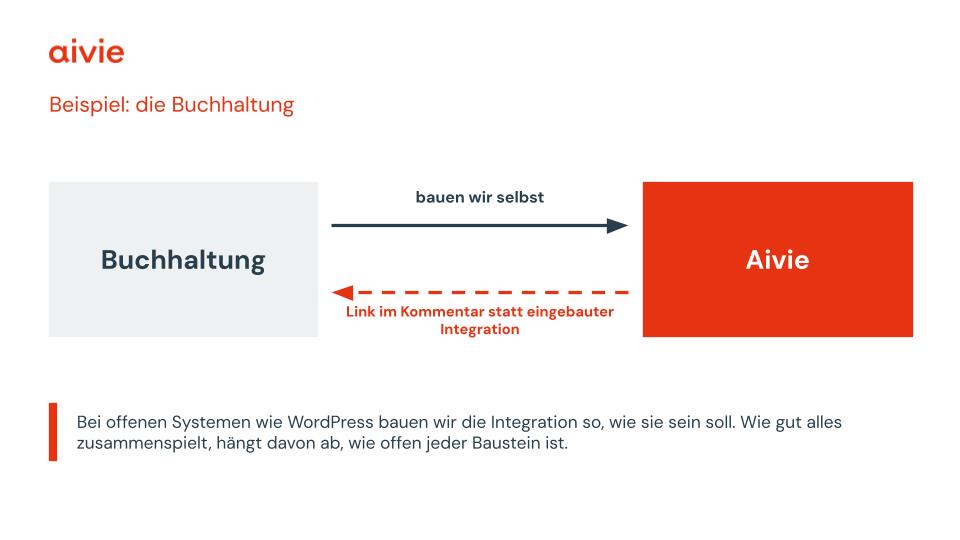
We build the connection to Aivie ourselves. Most providers today have an API for that. It gets trickier when you also want the connection from the other platform’s side. One example: you’re working in Bexio and want to jump to the matching contact in Aivie with one click. Right now we’ve solved this with a comment field containing the link. It works, but a native integration directly in Bexio would be nicer. And unfortunately, Bexio doesn’t exactly make that easy for us.
With open systems like WordPress, it’s different. There we can build the integration exactly the way it should be, and we’ve done that well. So how well a stack works together also depends on how open each individual building block is.
2. Something is sometimes missing at the start
Anyone switching from a large platform is used to certain features and quickly notices when one is missing. BODDY, for example, switched from HubSpot to Aivie and missed certain email statistics. We take that seriously: we work closely with BODDY and are building out exactly that capability. We describe how such a switch works in Migrating from HubSpot to Aivie.
3. Someone has to decide and prioritize
With many building blocks come many requests. Which feature comes first, and who builds it?
How we deal with the drawbacks
We have a Kanban board where we log and prioritize feature requests transparently. Our customers have visibility and help set priorities.
Then comes a step that only works this way with open source. If a request concerns Mautic itself, we implement it within the open-source community, and everyone using Mautic benefits from it. If it isn’t accepted there, or doesn’t concern Mautic at all, we implement it in Aivie.
Or customers implement it themselves, at no cost. We’ve seen that too: one company didn’t want to use Google reCAPTCHA and so built its own plugin for Friendly Captcha. We provided some support and reviewed the result. Now the plugin is available to them and to all other customers.
That’s the difference with open source: a request doesn’t have to wait until a single vendor puts it on their list. Someone can implement it themselves. I also describe what that means in practice in Open source works – the hard part comes afterward.
Which brings us to the real point. The big drawback of an open stack is that someone has to look after it. The solution isn’t to give up on the open stack. The solution is that someone takes care of it. You can do that yourself, or a company like Aivie can take care of it for you. You hand off the operations, but not the control.
My advice if you’re on a single platform today
Do you currently have everything on one platform? Then think carefully about whether you want to switch now. Because it only gets harder over time: more data piles up, more processes, and more employees working with it. Untangling it becomes more demanding with every passing month.
Many people say: we’ve already built so much, we can’t switch now. To me, that’s not a good argument. It’s like saying: the stock has already lost so much value, now I can’t sell it. If you no longer believe in the stock, you should sell and bite the bullet.
Start with your core data and ask yourself four questions:
- Where are my contacts stored?
- Who controls them?
- How expensive would it be to leave in two years?
- Where could I already switch today?
I explain why customer data in particular matters in Why you shouldn’t give up control of your customer data.
Conclusion
An open stack isn’t a toggle switch. You don’t have to change everything at once — you decide block by block. The mixing console is yours. Yes, an open stack needs upkeep. But you can hand off that upkeep without giving up control.
If you want to know how far you are today from an open stack: on the Stack page there’s a migration check that takes two or three minutes. And if you have questions afterward, get in touch with me.
All beginnings are easy
Whether you’re a marketing manager, CMO, CTO, CEO, founder or simply curious: we will discuss your individual case in a 30-minute online appointment.
Using a comparable customer use case, we will show you how marketing automation can be applied in your business.
The appointment is free of charge.
